Q&A: Homage
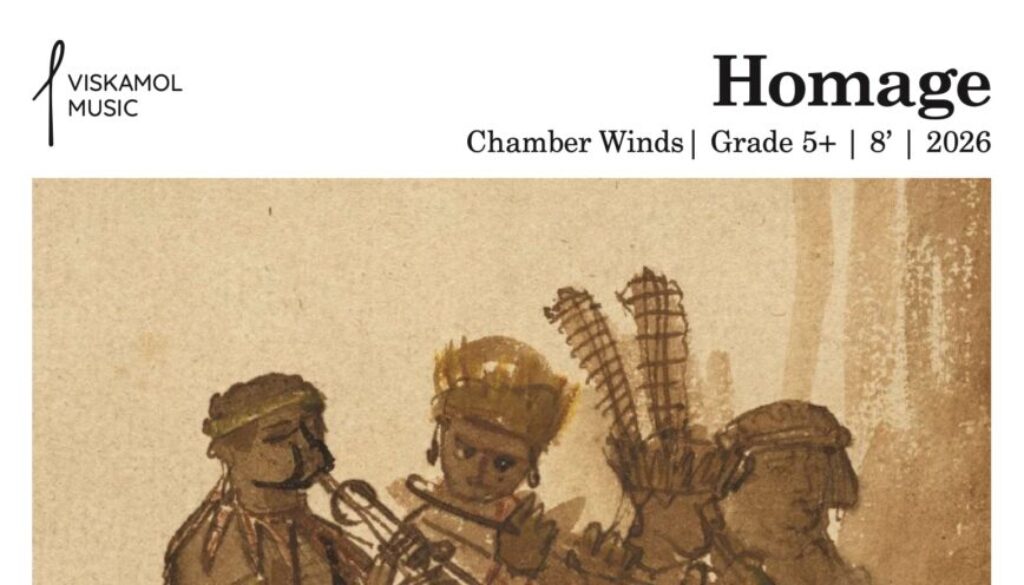
Initially, I composed this piece as an homage to chamber winds literature. As a conductor myself, I approached the writing with the mindset that this piece should contain several distinct conducting focus points that would be highly applicable for future conducting workshops. While the piece has recently received broader recognition through its various adaptations (especially the wind octet version), I am incredibly grateful that it is being programmed and performed more frequently at conducting symposia.
Many conductors working on the piece have reached out to ask questions about the score. I have truly enjoyed these conversations, and I realized that many of their questions could serve as helpful resources for other conductors studying the piece in the future. Therefore, I have compiled these questions and answers to serve as a practical guide for prospective conductors.
I would like to deeply acknowledge my close friend and collaborator on this project, Yuji Jones. Yuji conducted the world premiere of the piece, assisted with editing the music, and lent his valuable insights to the creation of this Q&A guide.
Origin & Evolution of the Piece
Q: What is the origin story of “Homage”?
A: I composed this piece as part of the Newfound Chamber Winds Summer Festival 2025. Initially, I wanted to compose for harmoniemusik (wind octet), but I was assigned to compose for a woodwind quintet. My aim was to write a piece that nodded to the neo-classicism I enjoy, while also creating something practical for conducting symposiums, as I am a conductor myself. I collaborated with conductor E. Yuji Jones on the premiere with the Newfound Chamber Winds, and we continued our collaboration to develop different versions of the piece.
Q: What are the different versions of “Homage” available?
A: The piece has evolved through several instrumentations:
- Woodwind Quintet: The original version assigned and premiered at the festival.
- Wind Sextet: An expanded version for woodwind quintet and piano.
- Harmoniemusik (Wind Octet): The version many people are now more familiar with. I composed this version as part of my conducting performance with the UMKC Conservatory Wind Symphony Chamber Players.
- Chamber Wind Ensemble: Commissioned in the summer of 2026 by the Newfound Chamber Winds. Special thanks to Tyler Austin and E. Yuji Jones for commissioning this latest version.
Q: Did the piece originally have a different title?
A: Yes, I originally titled it “Serenade” because of the chamber winds inspiration from various historical composers who wrote for the medium. Later on, I discussed the piece with one of my conducting professors at UMKC, Professor Steven Davis. He suggested that the piece sounded much more like a dedication to the music of the past and a nod to the people, composers, and music I admire. Based on that advice, I changed the title to “Homage,” which perfectly captures what I intended.
General Information & Inspiration
Q: What is the primary inspiration behind “Homage”?
A: “Homage” is a short four-movement piece that nods to “neo-classicism” while paying tribute to the composers and conductors from whom I have drawn inspiration. The piece was shaped by my studies in composition and conducting, particularly regarding writing for winds. I dedicate it to the conducting professors who nurtured my love for the wind medium.
Q: Who is “Homage” ultimately dedicated to, and what was the inspiration behind that dedication?
A: I ultimately dedicate “Homage” to the conducting professors and mentors who have inspired me, made me a better musician, and nurtured my love for the wind medium. Specifically, the dedication honors my school band directors Panlop Jeepsuwan and Bundit Chuenmaiwai, my first conducting teacher (undergraduate) Dr. Pamornpan Komolpamorn, my master’s degree conducting professor Asst. Prof. Dr. Thanapol Setabrahmana, and my doctorate studies conducting professors at UMKC, Steven D. Davis and Dr. Joseph Parisi.
Q: Are there specific classical or orchestral allusions in each movement?
A: Yes, while the other movements do not have direct quotations, each has its own distinct style acting as a homage to different composers and traditions:
- Movement I (Intrada): Features a fanfare-like opening with cascading scales and an obscure tonality. It includes a brief quotation from the prelude to Wagner’s Tristan und Isolde, set in a pointillistic texture reminiscent of Anton Webern.
- Movement II (Scherzo): References the styles of Leonard Bernstein and Igor Stravinsky while using the Thai Isaan Khaen texture.
- Movement III (Nachtmusik): References the impressionistic style of Claude Debussy, and Thai folk melody writing.
- Movement IV (Toccata): References J.S. Bach, Francis Poulenc, and Thai Traditional Boxing Music.
Q: Why did you choose Wagner and Webern specifically as the references for Movement I?
A: Most of the pitch collection in this piece is derived from the Tristan chord. When I studied music history, the revolutionary role of this chord in the breakdown of traditional tonality came up again and again, so I wanted to draw back to that moment of innovation by building Movement I around it.
Q: Why did you choose Bernstein and Stravinsky as the references for Movement II?
A: I have loved both composers since my undergraduate studies. The first time I heard Stravinsky’s Octet performed live as an undergraduate, I was blown away by the colors and the energy of the music. Then during my master’s studies, I came across Bernstein’s Profanation through a centenary celebration, and I felt that these two composers shared a remarkably similar sensibility. For the Scherzo, I wanted to draw on both of them as references to create something light and playful in mixed meter.
Q: Why did you choose Debussy and Thai folk melody writing as the references for Movement III?
A: Debussy is one of the composers I have always enjoyed listening to — particularly his harmonies and how his melodic lines interact with one another. I felt that Thai folk melody, as I use it in this movement, has a lullaby-like quality with a vocal flexibility and ornamentation that pairs naturally with Debussy’s blurry, impressionistic texture. The two influences complemented each other in a way that felt very organic.
Q: Why did you choose Bach, Poulenc, and Thai Boxing Music as the references for Movement IV?
A: For the final movement, I wanted to compose a toccata — ending the piece in a showy, virtuosic manner with a moment for each instrument group to shine. Bach is the obvious choice for toccata writing, so I used this movement as a direct homage to his counterpoint and keyboard toccata tradition. As for Poulenc, I was inspired by his Sextet — the quirky, fun energy he brought to chamber writing felt like exactly the right spirit for this finale. Thai boxing music then became the third pillar: the gesture of an accented, vertical punch captures the articulation and drive of the music perfectly, and it works hand in hand with the toccata character.
Cultural & Musical Influences
Q: How does traditional Thai music influence the rhythms and style of the piece?
A: In Movement II, I drew the drone elements directly from traditional Khaen music. I put a unique twist on this by utilizing mixed meters, giving it a character that should feel light and groovy. Movement IV is a vigorous finale driven heavily by the high rhythmic energy and style of Thai boxing music (Muay Thai).
Q: What is the historical context behind the Thai-Western hybrid performance practice in this music?
A: Around the WWII era, the government temporarily banned traditional Thai music and instruments through cultural mandates. Because of this restriction, traditional musicians had no choice but to adapt and port their music over to Western instruments. Instead of completely switching to standard Western repertoire, they chose to play traditional Thai music on Western instruments. This created a fascinating, unique hybrid of Thai-Western performance practice that I draw on directly for how conductors and players should approach the style of this piece today — especially in the wind octet version of Movement IV, where the 1st clarinet plays the solo boxing music melody.
Conducting & Performance Notes
Q: What specific reference recordings should I study to better understand the Thai musical influences in this piece?
A: To capture the appropriate style, I’d recommend studying traditional Thai music, which is very prominent in Movements II and IV.
- For Movement II (Khaen-inspired drones, light/groovy character): https://www.youtube.com/watch?v=Wjt3cyVyNn0
- For Movement IV (Thai boxing / Muay Thai rhythmic energy): https://www.youtube.com/watch?v=TH7zjuSMIrU
- For the Thai-Western hybrid performance practice (most important for understanding my overall approach): traditional Thai music adapted for clarinet, starting at the 6:22 mark: https://youtu.be/SorgHR88MFM?si=Hi9Bja7Vn1lco53g&t=382 — I especially recommend this for conductors preparing the octet version.
Q: How should I approach the texture and style of Movement I, given its disparate influences?
A: Movement I (Intrada) opens in a fanfare-like manner with cascading scales and an obscure tonality. While it includes a brief, direct quotation from the prelude to Wagner’s Tristan und Isolde, I wrote the texture itself in a pointillistic style reminiscent of Anton Webern. Conductors will need to balance the different gestures with the delicate, pointillistic texture of Webern.
Q: In Movement II, several 3/4 bars have accents on the 1st and 4th eighth notes. Should this be conducted in 3/4 or in a 2-pattern (like a 6/8 feel)?
A: As a conductor, I highly recommend keeping these measures in 3/4. I designed the syncopated accent patterns explicitly to play against and emphasize the internal pulse of a triple meter, rather than shifting the entire groove into a compound 6/8 feel.
Q: What is the core character of Movement III?
A: I wrote this movement (Nachtmusik) as a slow, lyrical interlude led by the horn (and saxophone in the chamber winds version), meant to evoke the calm and stillness of a night breeze. The trills are like a butterfly’s wing flipping.
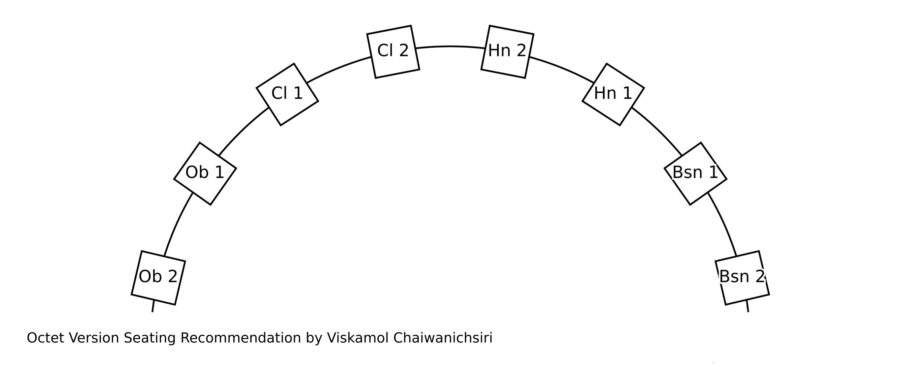
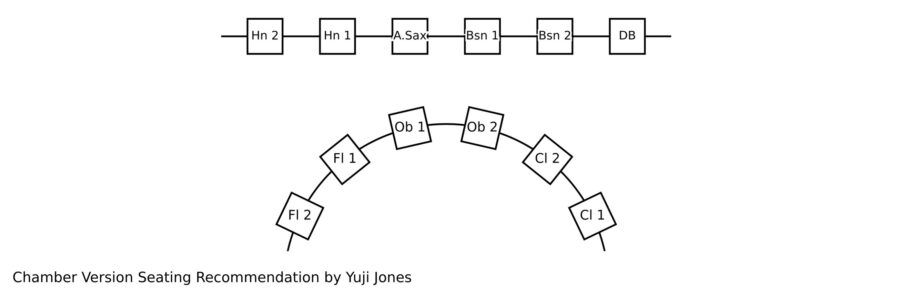
Q: Is there a preferred stage setup or seating arrangement, especially for the horn-led Movement III?
A: Conductors are free to set up the stage however is practical for them. That said, when I performed the harmoniemusik (wind octet) version myself, I preferred seating the principal players next to one another. From left to right: Ob. 2, Ob. 1, Cl. 1, Cl. 2, Hn. 2, Hn. 1, Bsn. 1, Bsn. 2.
Q: What drives the energy of the final movement?
A: The fourth movement (Toccata) serves as a vigorous finale. Alongside my homage to Thai boxing music, I drive the movement with high rhythmic energy and virtuosic interplay across the entire ensemble.
Q: In Movement IV, measure 104, what is meant by the fermata with two dots beneath it?
A: That notation simply means to extend the duration of the fermata longer than a standard hold. (Note: this was removed in the chamber winds version)